Microbiology and Business Culture
Every now and then I have folks that ask me what it’s like working for a startup versus a big company. I’ve been fortunate enough to have experienced both cultures: I interned at places like Intel and Sandia National Labs which are absolutely huge as well as worked for startups like Iff Technologies and QuEra Computing Inc.
I find that a great way to think of the two is to revisit some high school biology and think of the distinction between Prokaryotes and Eukaryotes.
Prokaryotes and Eukaryotes
This LumenLearning LibreText textbook section (4.1A: Characteristics of Prokaryotic Cells) served as a main source for most of the following paragraphs. Where supplementary information/sources have been helpful in my research, I have done my best to cite them in the footnotes.
Prokaryotes and Eukaryotes are the two categories all cells fall into1. There are a large number of distinguishing factors between the two but two in particular are the most relevant to business culture:
- The absence/presence of organelles (literally “mini organs”2) in the cell
- Cell size
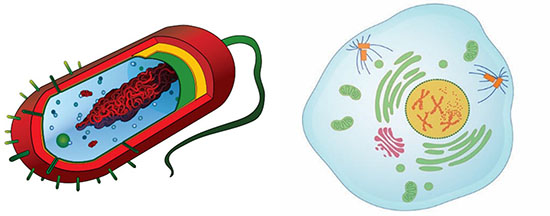
A Prokaryote (left) and Eukaryote (right) side by side: notice the lack of organelles in the Prokaryote as well as the lack of a nucleus enclosing the genetic material. Credit: Prokaryotes vs. Eukaryotes - Ask a Biologist - Arizona State University
Prokaryotes tend to be smaller than Eukaryotes and have a much simpler structure than Eukaryotes3. Most notably, Prokaryotes have no organelles (although ongoing research seems to be challenging this belief4) so all the chemistry that has to happen to sustain itself is sort of diffused throughout the cytoplasm (described as a “gel-like substance” primarily made of water5) and cell membrane that holds the cell together.
At small sizes, this setup tends to be fairly efficient: stuff that needs to go into the cell gets spread around quite quickly and any waste easily gets washed out. It’s good enough in fact, that relative to Eukaryotes Prokaryotes can metabolize and grow much faster6 7.
As you try to scale a Prokaryote however, you run into a problem: the volume of your cell tends to grow faster than the surface area8. Just relying on diffusion alone means you’ll eventually get to a point where incoming molecules take longer to reach the places they need to go and waste begins to accumulate. Furthermore, remember that there are all kinds of chemical reactions just happening “in the open”. With a larger volume you can imagine how inefficient this is, with molecules from one reaction inadvertently bumping into the molecules of another one with increasing frequency. I like to think of the following analogy: if your car’s battery and combustion engine reactions were forced to happen in some shared chamber it would be an absolute nightmare in terms of functionality!
Eukaryotes work around this by using organelles which are dedicated to specific functions, isolating reactions from different parts of the cell and relying on a more dedicated system (vesicles - literally something that wraps around molecules9) to get molecules to where they need to go. Eukaryotes are thus more efficient and able to scale to sizes much larger than Prokaryotes (1000x - 10000x increase in volume!)10. The “cost” to keep in mind though is that you now have additional structural complexity.
The Business Side
So what does that all have to do with startups versus large companies?
I want to make it clear that the observations I provide here aren't meant to be commentary about the individual places I worked at, in that regard I had awesome experiences at each one and got to learn so much from truly brilliant people while building great software.
Rather, these are more just challenges of an organic nature from having any number of people work in an organization. Individuals naturally have different ways they see and approach problems, and can have varying convictions on what the best way to tackle a problem should be. Having that diversity of thought is an incredible asset but also invites a degree of conflict to happen. I believe any healthy organization will have conflict, but how that conflict is resolved means all the difference between an organization that survives versus one that thrives.
Startups are very much like Prokaryotes: you don’t have much of a split between engineers and scientists or scientists and business people. New ideas can get pitched easily and buy-in established very quickly through diffusion: just tap whoever you need on the shoulder or make a group chat on < insert messaging platform of choice >!
At the same time, it’s not too difficult too imagine the problems that happen if you scale things up as-is: people get involved with things either prematurely or too late, sometimes conflicting and even opposite ideas (think chemical reactions with no compartmentalization) are built upon within the same team and without the right kind of coordination people can get frustrated pretty quickly.
The natural solution is some degree of compartmentalization, especially as the company grows: subteams are formed, hierarchies introduced, and stricter communication channels established (think vesicles and organelles). Thus, larger companies bear more resemblance to Eukaryotes11. The downside of this is you sacrifice some of the ease to start collaborations and buy-in on novel ideas takes longer as it may have to work its way through different teams. By the time an idea gets approved and other teams can work on it, a Prokaryote may have already beaten the Eukaryote to the punch!
That being said, as an engineer in a larger company you have more of an opportunity to feel like you’re tackling a tightly scoped problem as opposed to several completely different problems at once. While I admit a preference towards having different problems I can take turns alternating between, there’s something to be said about being able to tackle just one over a long period of time12.
Extent of Ownership
Another difference you’ll find between startups and large companies is the extent of ownership: If you have something you’ve worked on, how tied are you to it? How much of it continues to be something you’re part of? Is it something you see to completion and continue to support as its used by others or do you have to hand it off to somebody else? I think the ultimate benchmark of this is if you have an idea that’s relevant to the business, how long does it take to get approval to work on it and how far can you keep working on it?
In startups you’re expected to have a very high extent of ownership: you’ll build something and continue iterating on it until it releases, getting to see people directly interact with it and potentially incorporate what they ask for immediately. With larger companies that ownership can be limited: you can imagine this as being part of an organelle and once you’ve finished your part a vesicle will send it to a different organelle for further processing.
The limited range of extent shouldn't be interpreted as a bad thing: larger companies ideally have the ability (and the need!) to work on products that are larger in scale than what a smaller organization can handle, which can demand more structure and specialized talent than a startup can provide. In contrast, while a larger extent does sound cooler it also means a small number of individuals must essentially take on several roles. Size doesn't necessarily translate to success, and there will always be an abundance of problems to tackle, just different in nature.
Concluding Remarks
It’s worth keeping in mind that all the ideas I’ve presented here are very general and they exist on a spectrum: unlike cells organizations are not forced into one category13 and as a company grows it may opt for some intermediate structure or attempt to follow one direction as far as possible before pivoting.
If you’re considering what kind of place you’ll want to work in next I hope this post proves helpful in that endeavor! Despite the huge differences I found extraordinary value in my career working at both and made me a much better engineer in the process.
If you'd like to leave a comment or have a suggestion/concern, please feel free to reach out to me via my e-mail at: (my first name)z(first letter of my last name).dev@gmail.com
You can push this analogy even further with the fact that all multi-cellular organisms are Eukaryotic! If you think about really large businesses it's not unheard of they'll spin off a division to make a new company or split to survive, very much like multicellular life in the real world.
I also like it when I have potentially one or two large core problems to focus on followed by a mix of smaller ones.
Even in the domain of biology there is always the case something is discovered that doesn't seem to fit nicely into existing categories. Parakaryon myojinensis is an example of this, believed to fall neither into the category of Prokaryote or Eukaryote!